

Retatrutide vs. Tirzepatide: What's the Difference?
Disclaimer: Retatrutide is currently an investigational medication being studied in clinical trials and has not been approved by the FDA. This article is intended for educational purposes only.
Retatrutide vs. Tirzepatide: Why Are Patients Comparing These Medications?
As interest in medical weight loss continues to grow, many patients are hearing about a newer medication called Retatrutide and wondering how it compares to tirzepatide.
At Chronos Body Health & Wellness, we frequently hear questions such as:
- Is Retatrutide better than tirzepatide?
- How do the medications work differently?
- Should I wait for Retatrutide?
- What weight loss results have researchers seen so far?
While Retatrutide has generated significant excitement in obesity medicine due to encouraging clinical trial results, it remains an investigational medication that is currently in Phase 3 clinical trials and has not yet received FDA approval. Tirzepatide, meanwhile, is an established treatment with proven clinical outcomes and FDA-approved indications.
What Is Tirzepatide?
Tirzepatide is a medication that activates two important hormone pathways involved in weight regulation:
- GLP-1 receptors
- GIP receptors
These hormones help regulate:
- Appetite
- Blood sugar levels
- Feelings of fullness
- Food cravings
Many patients experience significant reductions in hunger, making it easier to maintain a calorie deficit and support long-term weight loss efforts.
Tirzepatide is currently FDA-approved for specific indications and is widely used in obesity medicine programs across the country.
What Is Retatrutide?
Retatrutide is an investigational medication that works differently.
Instead of targeting two hormone pathways, Retatrutide activates three:
- GLP-1
- GIP
- Glucagon receptors
Because it targets an additional metabolic pathway, researchers are studying whether Retatrutide may influence both appetite regulation and energy expenditure.
This unique mechanism is one reason why it has attracted significant attention in obesity medicine research.
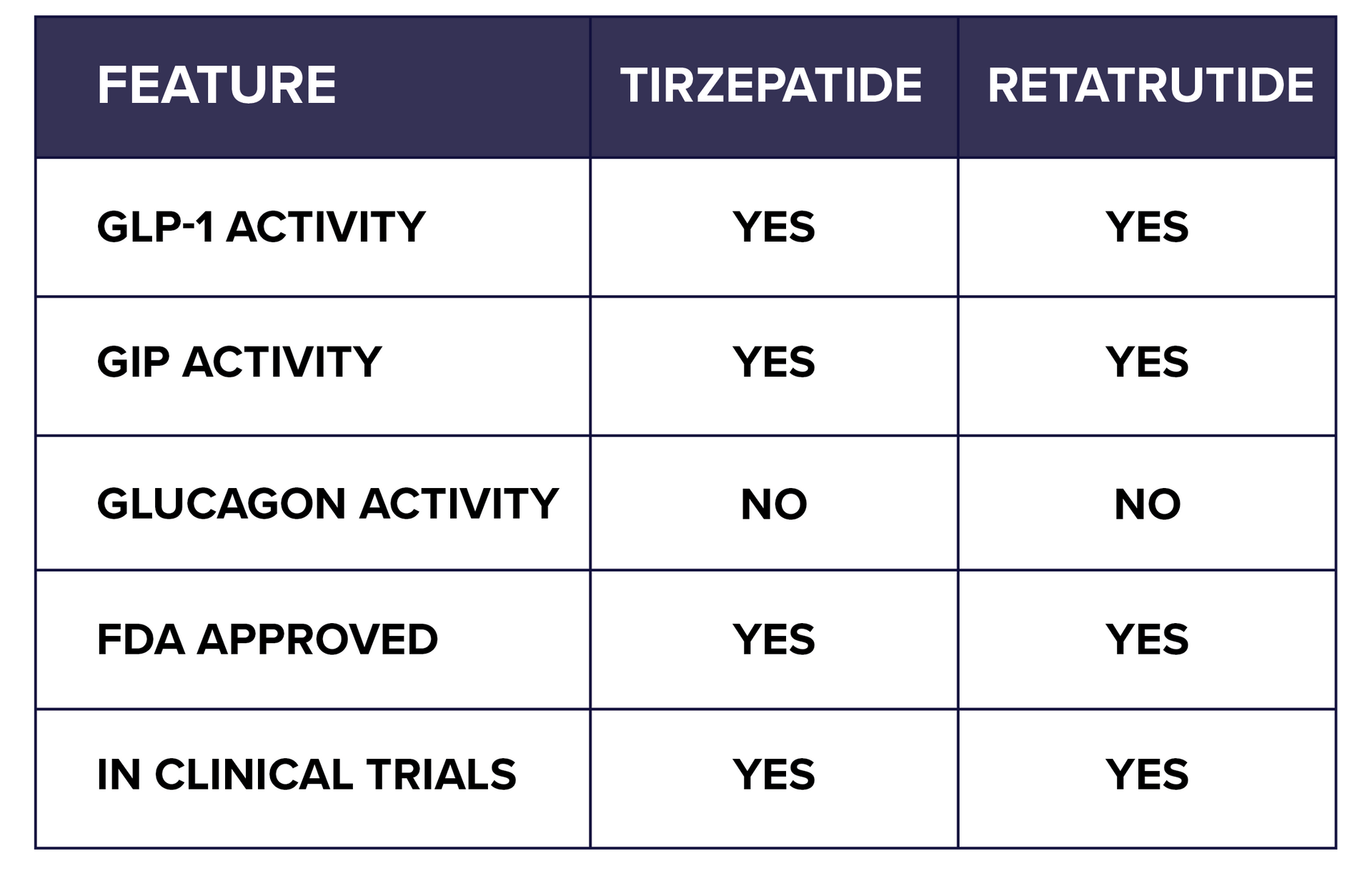
Retatrutide vs. Tirzepatide: Quick Comparison
Which Medication Produces More Weight Loss?
Early clinical studies of Retatrutide have reported impressive weight-loss outcomes, making it one of the most closely watched medications in obesity medicine. While those results are encouraging, direct comparisons between Retatrutide and tirzepatide should be interpreted carefully because the medications have been studied in different clinical trials with different patient populations, treatment durations, and study designs. Ongoing research will continue to clarify how they compare.
Should You Wait for Retatrutide?
The answer depends on your individual health history, goals, and timeline.
Retatrutide represents an exciting advancement in obesity medicine, and many patients are interested in its unique mechanism of action and promising clinical trial results. At the same time, tirzepatide has an established track record and remains an excellent option for many people seeking physician-guided weight loss.
The best choice isn't necessarily the newest medication. It's the treatment that's most appropriate for your individual needs after a discussion with your healthcare provider.
The Future of Weight Loss Medicine
The development of medications like Retatrutide highlights how rapidly obesity medicine is evolving.
Researchers continue to investigate:
- Triple hormone agonists
- Oral GLP-1 medications
- Combination therapies
- Muscle-preserving weight loss treatments
These advancements are helping reshape the future of obesity medicine and may expand personalized treatment options for patients in the years ahead. As research continues, providers will have even more tools to tailor treatment plans based on each patient's unique health goals.
Frequently Asked Questions
Is Retatrutide FDA-approved?
No. Retatrutide remains an investigational medication and has not received FDA approval.
Is Retatrutide better than Tirzepatide?
Current research shows promising results for Retatrutide, but the two medications have been studied in different clinical trials, making direct comparisons difficult. Both represent important advances in obesity medicine, and the most appropriate option depends on an individual's medical history, treatment goals, and a discussion with their healthcare provider.
Can I get Retatrutide through Chronos or Chronos Virtual?
Retatrutide is currently an investigational medication that has not received FDA approval and remains in Phase 3 clinical trials. If you have questions about Retatrutide or other medical weight-loss treatments, speak with a qualified healthcare provider to discuss the latest evidence and which treatment options may be appropriate for your individual needs.
Should I wait for Retatrutide before starting weight loss treatment?
Not necessarily. Treatment decisions should be based on your individual health needs rather than waiting for any single medication. A qualified healthcare provider can help you understand the current evidence and determine which approach best supports your long-term health goals.
What makes Retatrutide different?
Retatrutide targets three hormone pathways (GLP-1, GIP, and glucagon), while tirzepatide targets two (GLP-1 and GIP).
Written by Mace Scott, MD
Founder and Medical Director at Chronos Body Health & Wellness
Focus: medical weight loss, hormone optimization, wellness medicine, aesthetics
Updated: April 2026
Treating patients across Louisiana & Texas
Office located in Metairie, LA

Dr. Scott's Perspective
Every year, we see exciting advances in obesity medicine, and Retatrutide is one of the most promising medications currently being studied. At the same time, successful weight loss has never been about simply choosing the newest medication. It's about finding the treatment plan that's right for the individual sitting in front of you.
As research continues to evolve, our commitment remains the same: helping patients make informed decisions based on the latest evidence and their unique health goals. Whether discussing established therapies or emerging treatments, personalized care will always come first.