
MOXI “MENDS”: What Are the Tiny Dark Dots After Treatment?
You had your MOXI laser treatment. You're excited to see your skin looking smoother and brighter.
Then, a day or two later, you look in the mirror and notice something you weren't expecting.
Tiny dark dots.
Maybe your skin looks a little bronzed. Maybe it feels rough, almost like sandpaper. And now you're wondering:
Is this supposed to happen?
Yes. Those tiny dark dots after MOXI are often a normal part of the healing process. They're called MENDs.
It's one of those things that can look concerning if you don't know what you're looking at. But understanding what's happening beneath the surface can make the recovery process a lot less confusing.
Let's talk about what
MENDs actually are, why they appear, how long they last, and what you should (and shouldn't) do while your skin heals.
What Are MENDs After MOXI Laser Treatment?
MENDs stands for microscopic epidermal necrotic debris. It's a medical term for tiny amounts of treated skin tissue that work their way toward the surface following fractional laser treatment.
MOXI is a non-ablative fractional laser. Rather than removing the entire surface of your skin, it delivers controlled laser energy into thousands of microscopic treatment zones.
Your skin then begins its natural repair process.
As those treated microzones heal, tiny particles of cellular debris become visible on the skin's surface.
That's what we call MENDs.
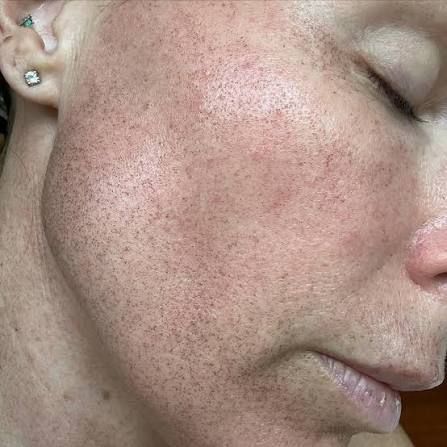
They may look like little brown or dark dots scattered across the treated area, sometimes giving the skin a bronzed or speckled appearance.
The important thing to understand is that MENDs are generally an expected response to MOXI—not automatically a sign that something went wrong.
Why Does MOXI Make Your Skin Look Darker Before It Looks Better?
This is probably one of the most surprising parts of MOXI recovery.
You get a treatment to improve uneven tone and texture, and for a few days afterward, your skin may actually look darker and feel rougher.
That can seem backward.
But here's what's happening.
MOXI creates microscopic zones of controlled thermal injury that stimulate the skin's repair process.
As the treated tissue moves toward the surface, it can temporarily create a bronzed appearance or tiny dark spots.
These particles gradually shed as the skin renews itself.
Your skin may look a little worse before it starts looking better. That doesn't necessarily mean the treatment isn't working.
However, not every dark spot after laser treatment is a MEND. New or worsening patches of pigmentation, blistering, or other unusual changes should be evaluated by your provider.
When Do MENDs Appear After MOXI?
MENDs commonly become noticeable around day two or three after treatment, although some patients see them sooner.
You might first notice that your skin feels tight or slightly rough.
Then you begin seeing tiny dark specks, particularly when you look closely in the mirror.
Some patients describe the appearance as:
- Tiny brown dots
- A bronzed or slightly dirty-looking complexion
- Little specks across the cheeks or forehead
- Rough, sandpaper-like skin
- A dry texture that doesn't feel like their usual skin
All of these can be consistent with normal MEND formation.
The amount you notice can vary based on your treatment settings, skin characteristics, and the area treated.
And if you don't see many MENDs, that doesn't automatically mean your treatment was ineffective.
How Long Do MOXI MENDs Last?
MOXI MENDs commonly begin shedding around days three through five after treatment. Some patients may notice roughness or flaking for longer, depending on their skin and treatment intensity.
Here's a general idea of what recovery may look like.
MOXI Healing Timeline: Day by Day
| Time After Treatment | What You May Notice |
|---|---|
| Day 1 | Warmth, redness, mild swelling, or tightness |
| Days 2-3 | Tiny dark MENDs become more noticeable; skin may look bronzed and feel rough |
| Days 3-5 | MENDs begin naturally shedding; mild flaking and dryness are common |
| Days 5-7 | Many patients notice smoother-feeling skin as the surface continues to recover |
| Following Weeks | Improvements in tone and texture may continue developing |
This is a general timeline, not a guarantee. Some patients heal faster, while others need more time.
The important thing is to let the MENDs come off naturally rather than trying to speed up the process.
Why Does Your Skin Feel Like Sandpaper After MOXI?
If you've had MOXI, you may know exactly what I'm talking about.
Your skin doesn't necessarily hurt, but it doesn't feel smooth either.
It feels dry.
Rough.
Almost like very fine sandpaper.
That texture is often related to the microscopic treated tissue reaching the skin's surface.
As the MENDs naturally shed, that rough feeling usually improves.
I know the temptation is to grab an exfoliating scrub and smooth everything out.
Please don't.
Your skin is still healing, and aggressive exfoliation can interfere with that process.
A little patience here is much more helpful than trying to force your skin to feel smooth again.
Should You Exfoliate or Scrub Off MOXI MENDs?
No. You should not scrub, pick, peel, or exfoliate MENDs off your skin.
This is probably the most important aftercare advice I can give.
I understand why patients want to do it.
You can see the little dots. You can feel the rough texture. It seems like removing them would help you get to the smoother skin underneath.
But those MENDs are part of your skin's normal healing process.
Removing them prematurely can irritate the treated area and may increase the risk of complications, including unwanted pigmentation changes or scarring.
Avoid using exfoliating scrubs, cleansing brushes, picking tools, or other abrasive products until your provider says your skin has healed sufficiently.
Let your skin do the work.
How Should You Care for Your Skin While MENDs Are Healing?
MOXI is often described as a low-downtime treatment, but low downtime doesn't mean your skin needs no aftercare.
For the first several days, I recommend keeping your routine simple and following the specific instructions from your treating provider.
1. Use a Gentle Cleanser
Choose a mild cleanser recommended by your provider.
Avoid scrubbing, rubbing aggressively, or using cleansing brushes while your skin is healing.
Gently pat your skin dry instead of rubbing it with a towel.
2. Keep Your Skin Moisturized
Dryness is common as MENDs develop and shed.
Using an appropriate moisturizer helps support the skin barrier and can make the rough texture more comfortable.
Your provider may recommend particular products based on your skin and the intensity of your treatment.
3. Protect Your Skin From the Sun
Sun protection is especially important after laser treatment.
Avoid unnecessary direct sun exposure, use the sunscreen recommended by your provider, and consider additional protection such as a wide-brimmed hat.
UV exposure during healing can increase the risk of unwanted pigmentation changes.
4. Put Your Active Skincare Products on Hold
This isn't the time to experiment with new products.
Retinoids, exfoliating acids, scrubs, and other potentially irritating ingredients may need to be paused until your skin has recovered.
Follow your provider's instructions about when to restart them.
5. Don't Pick at Flaking Skin
Even when the MENDs begin shedding, resist the temptation to help them along.
Avoid peeling off dry patches or rubbing away rough areas.
The best aftercare is often the simplest: cleanse gently, moisturize, protect your skin, and give it time.
Can You Wear Makeup While You Have MOXI MENDs?
According to MOXI manufacturer Sciton, makeup may generally be worn 24 hours after treatment.
However, your provider may recommend waiting longer depending on your treatment and how your skin is healing.
And there's something else worth mentioning.
Even when makeup is allowed, it may not sit quite the way you're used to.
That rough, sandpaper-like texture can make foundation look uneven or emphasize dry areas.
If you're planning MOXI before a wedding, vacation, photoshoot, or another important event, I'd recommend leaving enough time for your skin to recover.
Being able to wear makeup the next day isn't the same thing as your skin looking completely back to normal the next day.
Are MOXI MENDs the Same as Scabs?
Not exactly.
MENDs are microscopic debris associated with the fractional laser treatment zones. They may look like tiny dark specks and feel rough as they reach the surface.
Traditional scabs generally form as part of healing after a disruption of the skin's surface.
MOXI is a non-ablative fractional laser, so its usual healing response differs from more aggressive ablative resurfacing procedures.
If you're developing significant crusting, open areas, blisters, or symptoms that don't resemble the recovery your provider described, contact your treatment team.
Don't assume every change in your skin is simply a MEND.
Do MENDs Mean Your MOXI Treatment Worked?
MENDs can be an expected sign of the skin's response to fractional laser treatment, but they aren't a reliable way to measure how successful your results will be.
Some patients notice more visible dots than others.
Treatment settings, skin characteristics, and individual healing responses can influence how noticeable they are.
More MENDs don't automatically mean better results.
And fewer MENDs don't automatically mean your treatment wasn't effective.
What matters is how your skin responds over time and whether the treatment is helping address your original concerns.
MOXI is commonly used to improve the appearance of uneven tone, early sun damage, fine lines, and texture.
Those improvements shouldn't be judged based solely on how your skin looks during the first few days of healing.
When Should You Be Concerned About Dark Spots After MOXI?
Most tiny, evenly distributed dark specks that appear during the expected healing window are consistent with MENDs.
But there are situations where I would want you to contact your provider.
Reach out if you notice:
- Increasing rather than improving pain
- Significant blistering or open skin
- Spreading redness, warmth, or swelling
- Pus-like drainage
- Fever
- New dark patches that look different from the expected tiny dots
- Symptoms that are worsening instead of gradually improving
- Roughness or discoloration that persists beyond the recovery timeline your provider gave you
Seek prompt medical attention for severe symptoms.
It's also perfectly reasonable to contact your provider if you're simply unsure whether what you're seeing is normal.
I'd rather have a patient ask a question than sit at home worrying about something they don't understand.
How Long Until You See the Real Results From MOXI?
You may begin noticing smoother-feeling, brighter-looking skin once the MENDs have shed and the initial healing period has passed.
Sciton notes that visible improvements may begin around five to seven days after treatment.
But the full response depends on what you're treating and your individualized treatment plan.
Some patients benefit from a series of treatments rather than expecting one session to address every concern.
And the results can continue evolving as your skin recovers.
I encourage patients not to judge their MOXI results on day two or three.
That's often when your skin is still very much in the middle of the healing process.
Is MOXI Worth the Few Days of Rough Skin?
For patients who are appropriate candidates, MOXI can be a useful option for improving early signs of sun damage, uneven texture, and overall skin appearance without the recovery typically associated with more aggressive resurfacing.
But I don't want to suggest that MOXI is the right treatment for everyone.
Some concerns are better addressed with other technologies.
For example, a patient whose primary concern is redness or certain sun spots may benefit from a conversation about BBL HEROic, while deeper wrinkles or more pronounced texture changes may require a different approach.
The goal isn't to choose the trendiest laser. It's to choose the treatment that makes sense for your skin.
And part of that conversation should always include what recovery actually looks like.
Frequently Asked Questions About MOXI MENDs
What are the little black dots after MOXI?
The tiny dark dots are often MENDs, which stands for microscopic epidermal necrotic debris. They form as treated tissue moves toward the surface during the skin's healing process after fractional laser treatment.
Are MENDs normal after MOXI?
Yes. MENDs are a common, expected response after MOXI treatment. They may look like tiny brown dots and can make your skin feel rough or sandpaper-like for several days.
How many days do MOXI MENDs last?
MENDs commonly begin shedding around days three to five. Some patients experience dryness, flaking, or roughness for longer depending on their treatment intensity and individual healing response.
Can I wash my face when I have MOXI MENDs?
Yes, but follow your provider's instructions about when and how to cleanse. Gentle cleansing is generally recommended. Avoid scrubbing, cleansing brushes, and exfoliating products while your skin heals.
Can I put moisturizer over MOXI MENDs?
Yes. Keeping your skin moisturized with a provider-recommended product can help support healing and relieve dryness. Avoid irritating ingredients until your skin has recovered.
Can I pick off the tiny dark dots after MOXI?
No. Picking or scrubbing MENDs can irritate healing skin and increase the risk of unwanted pigmentation changes or scarring. Allow them to shed naturally.
Why does my skin look dirty after MOXI?
MENDs can give treated skin a temporarily bronzed or speckled appearance. This is related to microscopic treated tissue reaching the surface and usually improves as the debris naturally sheds.
Why is my skin rough three days after MOXI?
A rough, sandpaper-like texture around day three is commonly associated with MENDs. It usually improves as the treated microzones heal and the debris sheds.
Can I wear makeup over MOXI MENDs?
Sciton states that makeup can generally be worn 24 hours after MOXI, but follow your treating provider's instructions. Makeup may appear uneven while your skin is rough or flaky.
What if my MENDs aren't going away?
Healing times vary, but if the dark dots, roughness, or discoloration persist beyond the timeline your provider gave you—or if symptoms worsen—contact your treatment team for an evaluation.
Do MENDs mean MOXI is working?
MENDs are an expected treatment response, but their presence or amount doesn't reliably predict your final results. Skin improvements should be evaluated after healing and over the course of your recommended treatment plan.
Thinking About MOXI? Let's Talk About Your Skin.
At Chronos Body Health & Wellness in Metairie, we want patients to understand not only what a treatment can do, but also what to expect afterward.
That includes the little things that can be surprising when you look in the mirror a few days later.
Whether you're considering MOXI for the first time or comparing it with other laser and light treatments, our team can help you understand your options, recovery expectations, and what makes sense for your skin.
Because knowing what to expect is part of feeling confident about your treatment.
[Explore MOXI Laser Treatment at Chronos]
[Schedule a Complimentary Laser Consultation]
This article is for educational purposes and does not replace individualized medical advice. Healing times, aftercare recommendations, and results vary based on treatment settings, skin type, and medical history. Always follow the post-treatment instructions provided by your treating clinician.
Written by Lisa Lambert
Licensed Medical Esthetician at Chronos Body Health & Wellness
Focus: laser resurfacing, anti-aging, aesthetics
Updated: November 2026
This article is for educational purposes and does not replace individualized medical advice. Healing times, aftercare recommendations, and results vary based on treatment settings, skin type, and medical history. Always follow the post-treatment instructions provided by your treating clinician.